
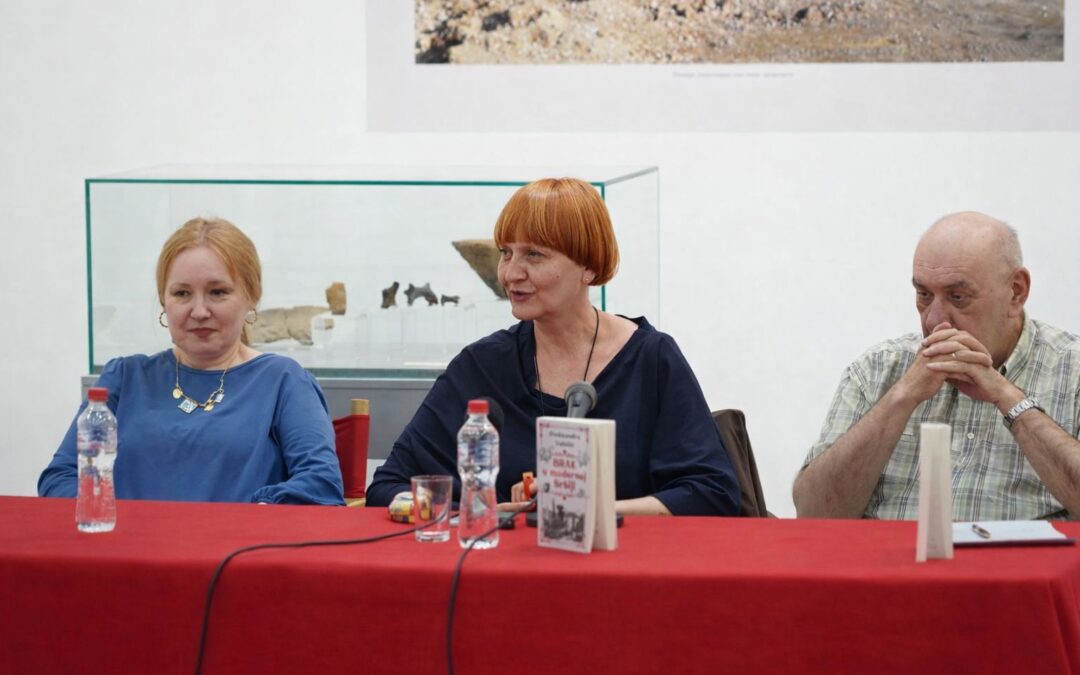
The promotion of the book by Aleksandra Vuletić “Marriage in Modern Serbia” was held at the Gallery of the National Museum Kraljevo, on Tuesday, May 12th, 2026, starting at 6 p.m.
At the beginning of the program, Darko Gučanin, director of the National Museum Kraljevo, greeted the audience and welcomed them to the presentation of the book Marriage in Modern Serbia by Aleksandra Vuletić, PhD, senior research associate of the Institute of History in Belgrade. In his address, he emphasized that historical science had long been primarily concerned with wars, political conflicts, and major state events, while topics of everyday life only later became subjects of serious research. He particularly stressed the importance of studying private life, customs, and social habits, noting that such themes require thorough and dedicated scholarly work.
He pointed out that Vuletić’s book is the result of many years of research and traces the development of marriage in Serbia from the time of the Serbian Revolution to the beginning of World War II. He reminded the audience that marriage, although experienced as a personal and emotional act, simultaneously reflects the broader social, legal, and cultural framework of its time. According to him, the book sheds light on the relationship between traditional understandings and attempts at modernization of Serbian society, as well as various aspects of private life across different social strata.
He emphasized that the work is intended for a wider readership but is based on extensive archival material and serious scholarly research, making it a significant contribution to Serbian historiography and culture as a whole.
He briefly presented the author’s biography, recalling her education, scholarly work, and research interests in social history and the history of private life, and then introduced the other participants in the program, giving the floor to Nebojša Jovanović, PhD, editor of the edition and representative of the publishing house “Laguna.”
Nebojša Jovanović expressed his joy at attending the presentation of a book dealing with a topic rarely addressed in historiography. He reflected on the title, noting that it contains two important concepts – marriage and modern Serbia – and that the title itself raises the question of what we mean by “modern Serbia,” i.e., which period is covered. He emphasized that this period spans from the Serbian uprisings to the present day.
Speaking about Serbian historiography, Jovanović reminded that it has largely focused on wars, battles, occupations, celebrated heroes, and important generals, but that no one until now had placed the institution of marriage at the canter of research and situated it within the context of Serbian history. He stressed that marriage is in fact the oldest institution of human civilization, present in the life of every person, and will exist as long as civilization itself.
He highlighted the originality and value of the work in the fact that Aleksandra Vuletić was the first to unite the concepts of marriage and modern Serbia into a single narrative, producing a fascinating manuscript. He praised the way the book is written, noting that although the author works in a scholarly institution, she did not write for a narrow circle of reviewers and experts, but for every reader. In this, he said, lies the true difference between a scholar and a writer – a good writer writes for a broad audience, not for committees.
He concluded with the conviction that the book will be translated into other languages and become an important reference work for the study of Serbian, regional, and broader social and cultural history, and that it can be read “in one breath” despite the seriousness of its subject.
Katarina Mitrović, PhD, research associate of the Faculty of Philosophy, University of Belgrade, began her presentation by noting that although she primarily studies the Middle Ages, she devoted herself with great pleasure to reading the book, finding the 19th century in some sense an “exotic” theme. She emphasized that the book interested her so much that she read it in just a few days, expressing delight at the way it is written and the topics it opens.
She pointed out that reading this book provides a complete cross‑section of society – private life, general history, economy, and social critique. She stressed that the book dismantles the idealized image of the “good old days” and shows that family conflicts, unhappy marriages, poverty, violence, abductions of girls, and numerous social injustices existed in the past as well. She noted that much of the narrative is based on archival material, church and court records, which reveal the real lives of people of that time.
She discussed specific themes from the book, such as the buying and selling of girls, noting that this was not merely a symbolic custom but a very real economic practice in a poor society where female labour in households had great value. She described cases of young men who could not afford the purchase price and would abduct girls or live with them illegally, as well as pregnant girls whose fathers avoided responsibility, leading to arrangements where someone would agree to take them for money.
She reflected on differences between rural and urban environments, noting that in towns women married later and that there was a phenomenon recognizable today as “smiling depression”. She emphasized how often relationships were cold and how marriages were rarely contracted out of love, but almost always for some interest.
Mitrović paid special attention to the way the author portrays the position of women in society and the complex relationship between state, church, and family in regulating marital relations. She noted that the book shows how life often could not fit into strict legal and church frameworks but always found its own paths and solutions.
She mentioned the 1862 law prescribing what kind of girl an officer could marry – she had to be from an urban environment, from a wealthy and respectable family, and of moral conduct, so that the officer would not have financial worries and could devote himself to service. With a humorous remark that today this would seem discriminatory, Mitrović acknowledged that the principle had its logic.
She spoke about the jurisdiction of church and state in regulating marriage, cases of murders and infanticide, attempts by authorities to protect vulnerable women by introducing forms of supervision, and how life always found its way beyond all church canons and state laws.
She assessed that the value of the book lies in the fact that it is scientifically grounded yet very readable and accessible, making it interesting both to experts and to a wider circle of readers.She concluded that the work greatly contributes to understanding Serbian society during the formation of the modern state and will certainly have an important place in domestic historiography.
At the end, with visible emotion, she revealed a personal connection to the venue, noting that her maternal grandfather attended the Gymnasium in the 1930s in the building that today houses the National Museum Kraljevo.
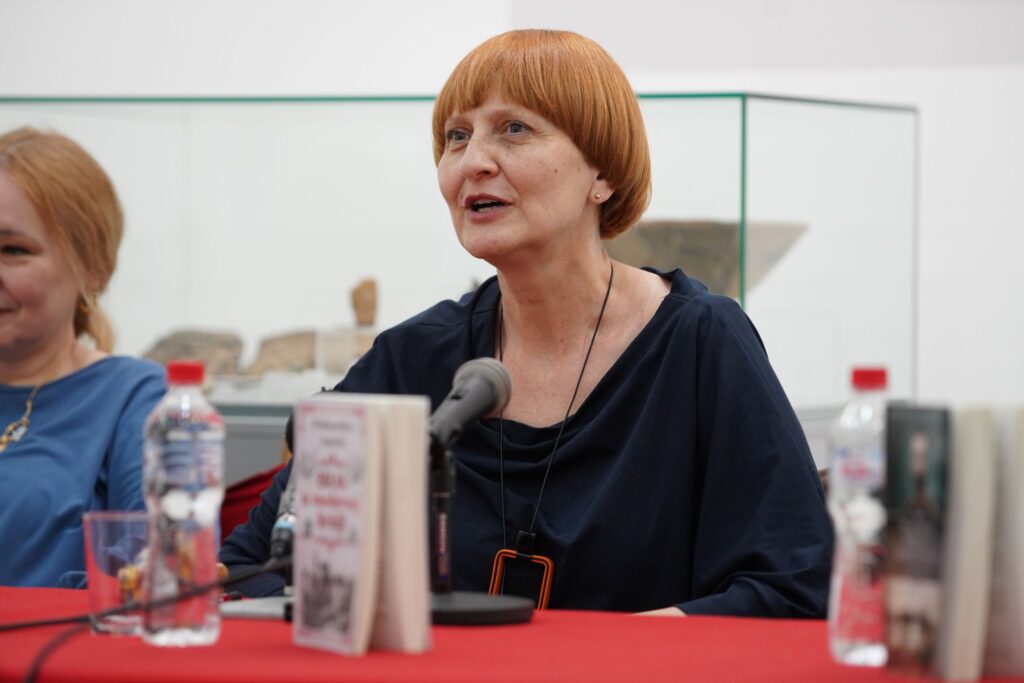
In her address, Aleksandra Vuletić, PhD emphasized that the book Marriage in Modern Serbia was based on her doctoral dissertation defended in 2008, but that in this edition the scholarly text was adapted for a wider readership. She noted that the impetus for publishing the book in this form came from editor Nebojša Jovanović, PhD, who suggested turning the complex scholarly work into a more accessible and readable book.
The author explained that she sought to retain scholarly grounding while bringing closer to readers the everyday life of ordinary people in Serbia in the 19th and early 20th centuries. According to her, the main characters of the book are not rulers and politicians, but people from various villages and towns of Serbia, whose destinies, marital relations, and family lives can be traced through archival material, court records, and church documents.
Vuletić stressed that one of the main goals of the book was to show how the building of modern Serbian society unfolded in parallel with the building of the modern state. She reminded that already during the First Serbian Uprising measures were introduced to regulate family and marital relations, such as prohibiting abductions of girls, purchase of brides, and infanticide. In this way, she noted, the state gradually sought to regulate areas of life previously left to customs and local practice.
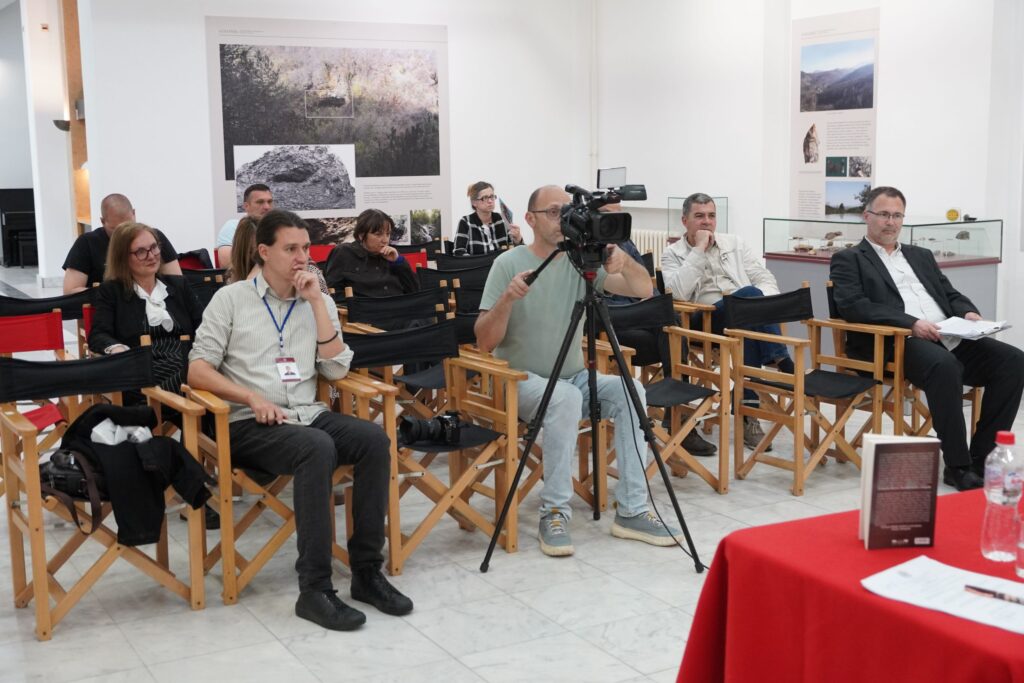
Answering a question from the audience about marital relations under Ottoman rule, the author explained that marriage was formally under the jurisdiction of the church, while Ottoman authorities generally did not interfere. However, due to weak institutions and lack of organized church and state control, many customs not in line with church regulations persisted among the people. She particularly pointed to phenomena such as arbitrary divorces, abductions of girls, and local resolution of marital disputes, which authorities in the 19th century gradually sought to suppress.
She emphasized that in her research she used many archival sources – from documents of state institutions and legal regulations to marital lawsuits and records of church courts – which provide valuable insight into the everyday life of people of that time. According to her, these sources made it possible to reconstruct personal stories, emotions, and social relations behind historical processes.
At the end, she thanked the audience, organizers, and participants of the promotion, expressing her joy that the book had attracted interest both from the scholarly community and from a wider circle of readers.
Anđelija Petrović
Editor of the Informative Program
of the Official Internet Presentation of the National Museum Kraljevo