
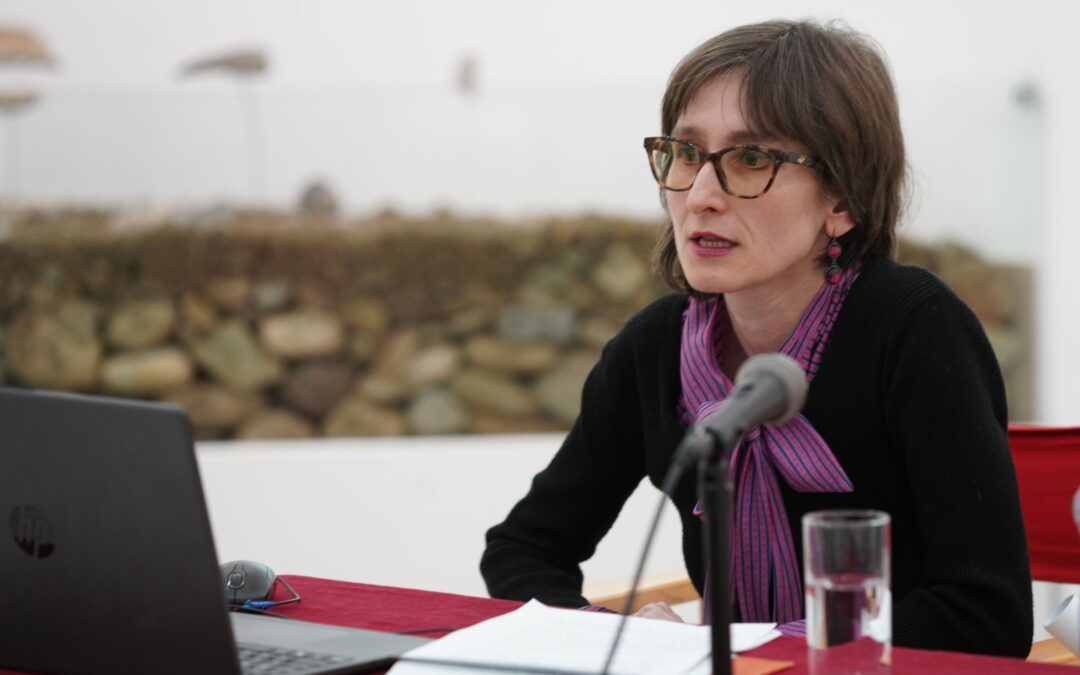
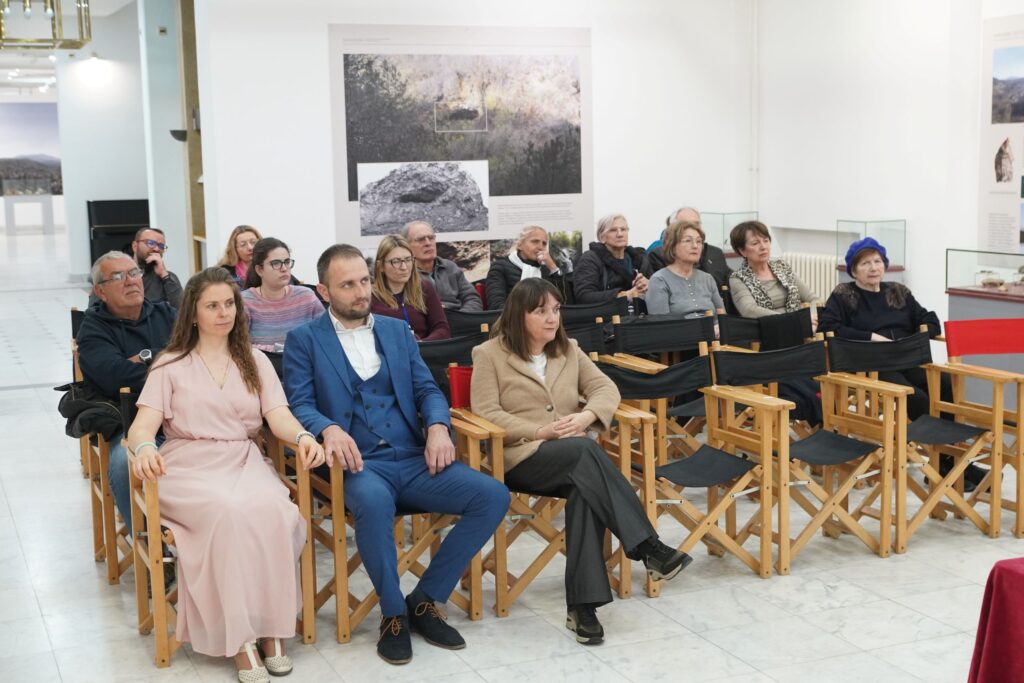
The lecture by Bojana Stevanović, PhD, entitled “Serbian Medieval Ruler Portraits in the Time of King Milutin” was held at the Gallery of the National Museum Kraljevo, on Tuesday, March 31st, 2026, starting at 6 p.m. At the beginning of the program, the audience was welcomed by Tatjana Mihailović, PhD, museum advisor of the National Museum Kraljevo, who introduced Bojana Stevanović, PhD, research associate at the Institute for Art History of the Faculty of Philosophy of the University of Belgrade. She emphasized that Bojana, already as a student accompanied by Professor Dragan Vojvodić, participated in professional practice at the National Museum Kraljevo, researching fragments of frescoes from the Žiča Monastery and the church in Radošići. She remained connected with the institution for many years, so it was a special pleasure that she would give a lecture this evening on Serbian medieval ruler portraits from the time of King Milutin.
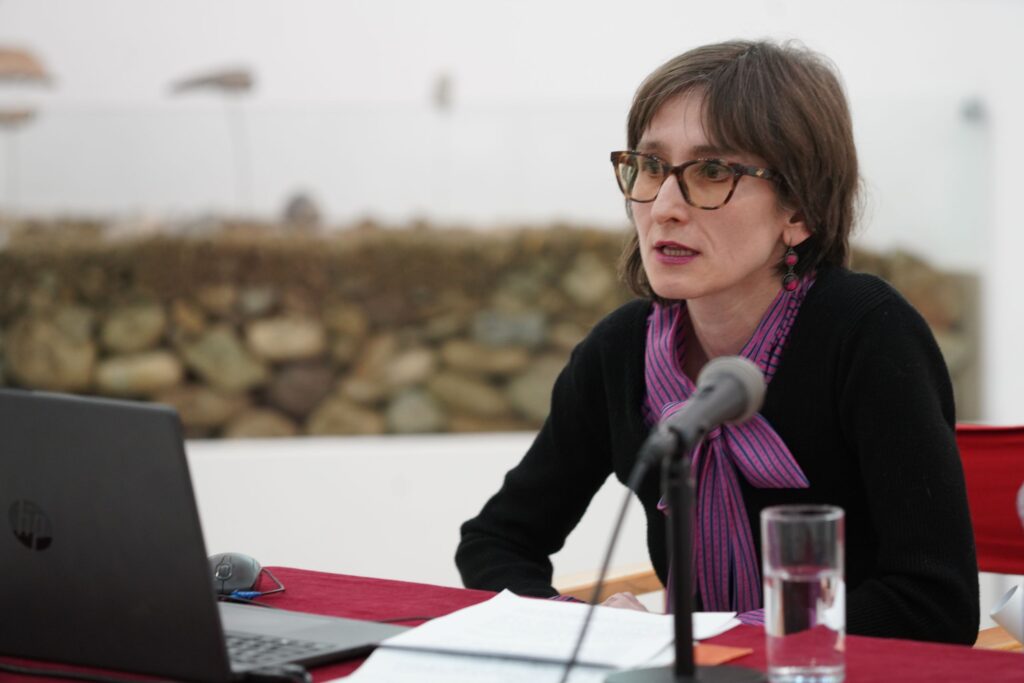
After that, Bojana Stevanović addressed the audience, greeted those present, and thanked them for the invitation to speak in Kraljevo. She emphasized that the topic of her lecture was also the subject of her diploma thesis, defended in 2008. The lecture was accompanied by numerous photographs and examples from Serbian medieval churches. Some of them represent endowments of King Milutin, while others belong to the broader cultural and artistic framework of that period. She stressed that the presentation was not limited only to portraits of this ruler, but also included depictions of other rulers and members of the dynasty from the time frame under consideration, relating to the reign of King Milutin, from 1282 to 1321. She then explained the significance of the portrait as an artistic genre. She emphasized that a portrait is not only a depiction of the physical appearance of an individual or group of people, but also a way to express their character, social position, political role, and spiritual affiliation. In medieval Serbian art, the portrait has a special function: it highlights social status, religious beliefs, relationship to God, the role of the endower, and historical importance.
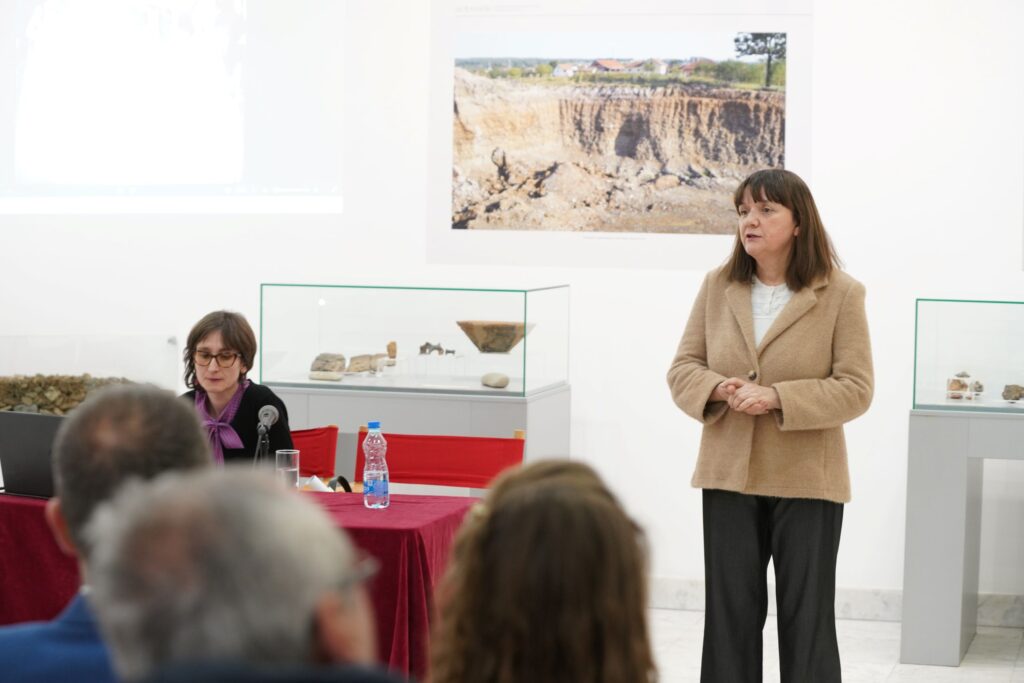
She emphasized that portraits in medieval churches appear in a religious context and that already in the 13th century, recognizable compositions of ruler portraits, so‑called horizontal genealogical lines, existed in Serbian endowments. Examples of such depictions can be seen in monasteries such as Mileševa, Sopoćani, and Gradac. The movement toward the representative ruler’s image, modeled on Byzantine portraits, is not only a characteristic of the time of King Milutin, when Byzantinization was at its peak, especially after 1299 and his marriage to Simonida. The aspiration toward representative depiction of rulers, shaping the ruler’s image modeled on Byzantine imperial portraits, is visible already during the reigns of King Uroš and King Dragutin. Realism reached its peak in the time of the Palaiologoi, which is also noticeable in portraits created during the reign of King Milutin. Serbian medieval art, alongside Georgian art, has the largest number of preserved ruler portraits in Eastern Christian iconography.
On the northern vault of the chapel in Đurđevi Stupovi, which was built thanks to King Dragutin in the period after the change of power, King Milutin and his brother King Dragutin are depicted. This composition shows a historical event – the transfer of power, which took place after Dragutin fell from his horse and ceded the throne to Milutin in 1282. King Dragutin holds in his hands a rather realistically represented model of a church, which he donates.
In this composition other family members are also depicted: Dragutin’s son Vladislav, his wife Catalina, as well as Milutin and his wife. In scholarship there have been debates about which of Milutin’s wives is shown on the fresco. Based on research and old records, it is considered to be Queen Jelena. The composition was created in the spirit of 13th‑century art: the figures are not placed completely frontally, but a certain dynamism and relationship between the characters can be seen. However, later a new type of representation appears – the frontal, ceremonial portrait of the ruler, modeled on Byzantine imperial depictions. It is particularly interesting that Milutin and his wife are shown precisely in this way: standing frontally, as a representative ruler couple, under the blessing of Christ. This is an important change in Serbian art, because for the first time the formula of frontal representation of the ruler as a ceremonial and symbolic depiction of power is introduced.
Chronologically, the next depiction of Kings Dragutin and Milutin is the icon of Saints Peter and Paul, which Queen Jelena of Anjou donated to the Vatican. The icon is divided into several registers: in the upper register is Christ giving a blessing, in the central register Saints Peter and Paul are depicted, while in the lowest register Queen Jelena is shown in a proskynesis posture, most likely before the pope of that time, with her sons Dragutin and Milutin depicted to her left and right. The icon is dated to the year 1290, while its arrival in the Vatican is placed in the period between 1291 and 1295. Below the Holy Apostle Peter, King Milutin is depicted, who, as the current ruler, was given a more prominent position. Both rulers are shown in a prayerful posture, dressed like Byzantine emperors.
She then spoke about the depiction of the ktitor King Dragutin and the ruler King Milutin in the Church of Saint Achillius in Arilje. The figures are depicted in complete frontality. For the first time the rulers are shown standing on red cushions (supediones). Dr. Stevanović notes that the portraits are quite realistic, meaning that facial features recognizable on different depictions of King Milutin can be identified, such as lowered eyes and a hooked nose. She also points out changes in fashion and the way ruler’s clothing is depicted, which can be traced through portraits over time. In the inscriptions next to the ruler’s figures their titles are also given. King Dragutin is signed as Stefan, king and first ktitor, while King Milutin is designated as Stefan, king of all Serbian and maritime lands, which emphasizes his authority and political status. King Dragutin holds the model of the church he donates, while King Milutin is depicted with ruler’s insignia: he holds a cross‑shaped scepter and an akakia (a small scroll or pouch containing dust, reminding the ruler of the transience of life). Both rulers are dressed in ceremonial Byzantine garments – divitision, with loros and identical crowns. Next to King Dragutin is Queen Catalina, shown frontally, with a crown. She pointed out the difference in the treatment of male and female portraits. This portrait of Queen Catalina is the first to introduce the fashion of depicting queens without any distinctive portrait characteristics. It is also interesting that the rulers’ children are depicted separately, on another wall in the narthex of the church. There young Vladislav and Urošic are shown. These portraits, based on inscriptions, are dated around the year 1296.
The next depiction is from King Milutin’s endowment, the Church of the Virgin of Ljeviša in Prizren, where on the southern wall of the eastern part of the narthex the portrait of King Milutin is painted in full frontality on a red background, while on the opposite side was painted the portrait of his father King Uroš, who was also the first ktitor of the church. It is particularly emphasized that the portrait is painted on a red background, which is the color of imperial power and ruler’s dignity. Although there are other portraits on such a background, this one stands out for its solemnity and importance. According to some researchers, this cycle of portraits represents one of the last horizontal depictions of the Nemanjić lineage in Serbian iconography. King Milutin is depicted in full ruler’s dignity, dressed in luxurious imperial attire. He wears ceremonial clothing adorned with jewels, a loros (imperial belt that was a symbol of Byzantine authority), as well as a richly decorated crown. The crown has rows of ornaments called pretendoulia (decorative chains hanging from the crown). In his hands he holds insignia of power, such as a scepter or other symbols of ruler’s authority. It was particularly emphasized that such a depiction of the ruler was largely taken from Byzantine imperial tradition. In Byzantine ceremony each part of the ruler’s regalia had its meaning. The cross is a symbol of the ruler’s Christian faith, while the crown is a sign of his dignity and divine blessing of authority. The belt indicates the ruler’s military role, the imperial attire shows his authority and position, and the special object the ruler holds (called akakia) reminds that the ruler is a mortal man and must not become arrogant. In Byzantine court ceremony a large candle was carried before the ruler, which symbolically pointed to the Gospel message: that the light of good deeds should shine before people. This motif also appears in painting – the depiction of a candle‑bearer before the ruler recalls the solemn court protocol.
She went on to speak about the broader painting program and ruler depictions on the eastern wall of the Žiča tower, then in Milutin’s endowment, the King’s Church in Studenica dedicated to Saints Joachim and Anna, where Queen Simonida was for the first time depicted holding a scepter. Characteristic of this depiction is that all figures are shown in the same row: to the east Christ, Joachim, and Anna, and on the opposite side the holy ancestors Stefan Nemanja, Stefan the First‑Crowned, and Saint Sava. Sometimes these portraits are connected with scenes in which the ruler offers a model of his endowment (church) to Christ or a saint, which is a common motif in medieval art. In this way it is shown that the ruler is the ktetor, that is, the builder and protector of the temple. She then explained the appearance of an important iconographic innovation: the depiction of the investiture of weapons, visible in the representation of King Milutin from his endowment Staro Nagoričane from 1313. In this depiction Saint George presents a sword to King Milutin. King Milutin’s endowment, Gračanica, is known for the vertical depiction of the Nemanjić lineage, a composition that emphasizes the sacred origin of the dynasty. Interestingly, at the very top of the lineage stands King Milutin, while angels lower a crown and a loros to him, as a depiction of the divine investiture of the ruler. This means that power is given to the ruler by God, which in art is sometimes represented by angels bringing a crown to the ruler or crowning him. This idea has roots in Byzantine tradition and connects Serbian rulers with the model of Christian emperors, such as Constantine the Great.
Stevanović pointed out that in the later period of Milutin’s reign realism reached its peak. The ruler allowed himself to be depicted without embellishment, with gray hair and wrinkles, which indicates that the portrait no longer represented only an idealized image of power, but a man in old age. She also mentioned specific portraits from the Hilandar Monastery, which were probably created according to models sent from Serbia, since the painters likely did not personally know the ruler. Historians and chroniclers of that time also describe the wealth and splendor of the ruler’s regalia. It is stated that King Milutin’s court was exceptionally ceremonial, and his crown adorned with pearls and precious stones. These descriptions correspond to the way he is depicted in frescoes.
Finally, she emphasized that ruler portraits in Serbian churches had multiple roles: they were a historical record of rulers, showed their piety and role as ktetors, emphasized the continuity of the dynasty, and conveyed a political message about the divine origin of power. For this reason, these portraits were placed in visible places in the temple, where believers could see them and recognize the significance of the ruler in the spiritual and state life of medieval Serbia.