

The lecture by Nenad Karamijalković, Assistant Director of the Institute for the Protection of Cultural Monuments in Kragujevac, titled “Crime and Punishment: The Fate of Wehrmacht Officers Responsible for the Kraljevo and Kragujevac Massacres of 1941”, was held at the Gallery of the National Museum Kraljevo on Tuesday, December 2nd, 2025, beginning at 6:00 p.m. The event marked 84 years since the last day General Franz Böhme spent in Serbia.
At the opening, Darko Gučanin, director of the National Museum Kraljevo, welcomed the audience and reminded them of the tragic events of 1941. He emphasized the significance of Hitler’s order of September 16th, 1941, addressed to Wilhelm Keitel, Chief of the High Command, demanding that “the strictest measures be taken to restore order in Serbia”. This directive became the foundation for subsequent crimes, as Keitel decreed the infamous rule: 100 civilians executed for every German soldier killed, and 50 for every wounded, a principle that led to mass reprisals and suffering in Kraljevo, Kragujevac, and across Serbia.
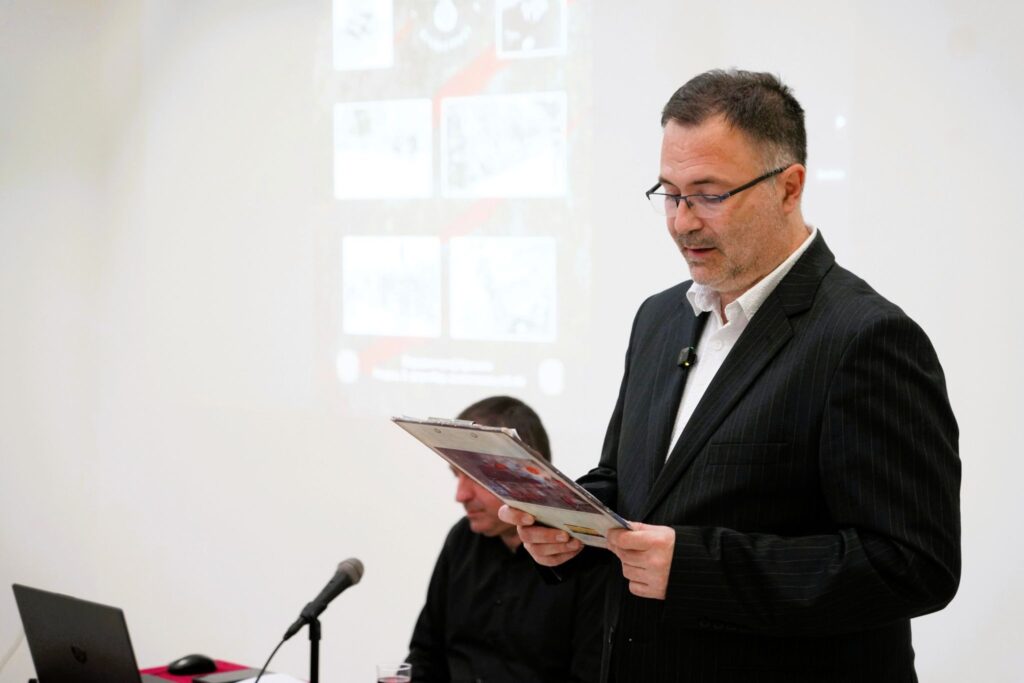
Darko Gučanin stressed that one of the museum’s lasting missions is to preserve the memory of all innocent victims and to continue uncovering and presenting the truth about those responsible for these unimaginable crimes. This mission inspired the evening’s lecture, dedicated to the officers who carried out the orders, their personal fates, and the question of whether – and to what extent – they were punished.
The audience was introduced to the academic and professional background of Nenad Karamijalković, anthropologist, curator, conservator, and archivist. Through his work in Kragujevac’s cultural institutions, he earned three professional titles in the field of cultural heritage protection, making him one of the rare, perhaps unique, experts of this kind in Serbia.
In his introduction, Karamijalković emphasized that the Kraljevo and Kragujevac tragedies of October 1941, among the greatest crimes committed by German troops in World War II, still lack a historical and moral epilogue until three key conditions are met: identification of victims, verification of perpetrators’ fates, and unequivocal repentance by Germany and Austria. He noted that historians Silvija Krejaković and Staniša Brkić fulfilled the first condition through their monographs “Identities of Victims Executed in Kraljevo, October 1941” and “Name and Number.” The second condition was largely illuminated by anthropologist Viktor Bejatović in his book “Spectrum of Death” and other studies, while Karamijalković himself continues this research. The third condition – public and sincere repentance – was only partially addressed by Claudia Roth, Vice President of the Bundestag, who offered an apology in Šumarice in 2021.
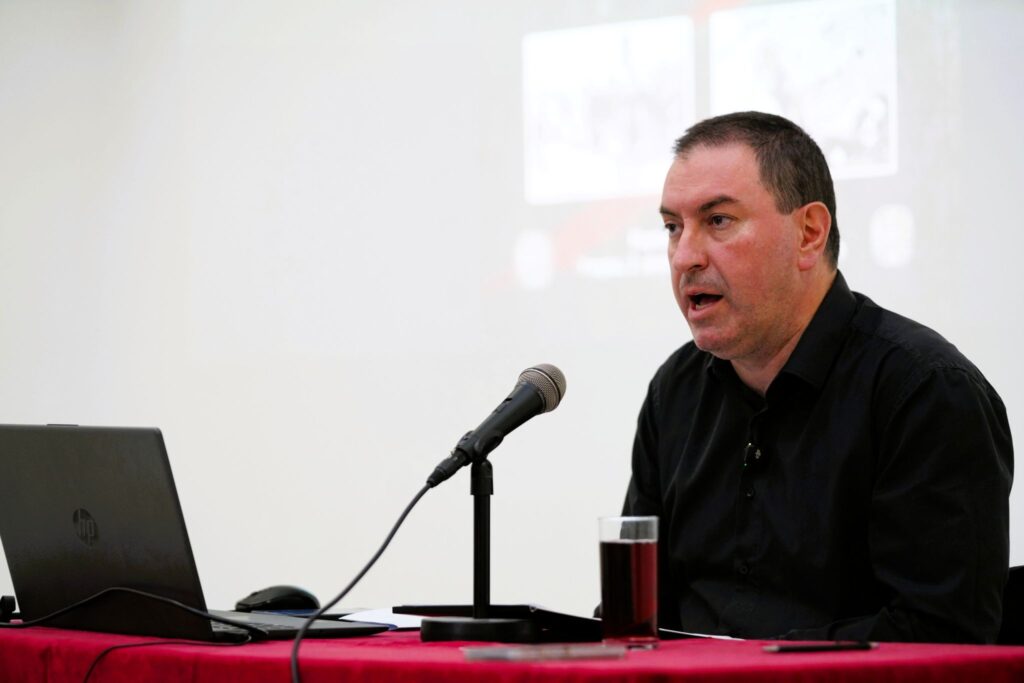
Nenad Karamijalković presented comprehensive research on the Wehrmacht officers most responsible for the massacres in Kraljevo and Kragujevac, highlighting three key figures: General Franz Böhme, Major Otto Desch, and Major Paul Koenig. Their biographies, ideological frameworks, and postwar fates serve as crucial testimony to the nature of the crimes and the subsequent culture of impunity.
Franz Böhme was portrayed as an officer deeply shaped by the traumas of World War I and Austria’s defeats by Serbia. His order of September 25th, 1941, calling for “revenge for 1914” and demanding a “terrifying example” for all of Serbia, illustrates the fusion of personal and Nazi ideology. Though one of the most responsible for mass reprisals, Böhme was never tried; arrested by the British, he committed suicide in 1947 before the start of the Nuremberg trials.
Otto Desch, as the direct commander of executions, bore field responsibility. Belonging to one of Germany’s wealthiest families, his social position likely contributed to his postwar protection.
Though investigated in postwar Germany, he was never prosecuted, with proceedings halted due to alleged poor health. He died in 1972 as a free man.
Paul Koenig, theologian and professor, remains a complex figure due to the absence of his military file. Myths and false accounts of his death circulated, but records show he lived in Zwickau until 1948, after which his trail disappears. Despite being listed as a UN war criminal, he was never arrested or charged. Testimony from
soldier Max Erwin Keller, describing him as arrogant and cruel, best illustrates his moral profile.
Karamijalković also detailed the fates of other senior Wehrmacht officers in Serbia, including Wilhelm List, Paul Bader, Heinrich Borowski, Adalbert Lončar, Paul Hofmann, Günther von Bischoffshausen, and Walter Zimmermann. Except for Lončar, executed in Belgrade in 1947, most lived long lives without facing consequences, despite their immense command responsibility. These facts, he noted, reflect indifference and political circumstances that allowed only a small number of perpetrators to be prosecuted.
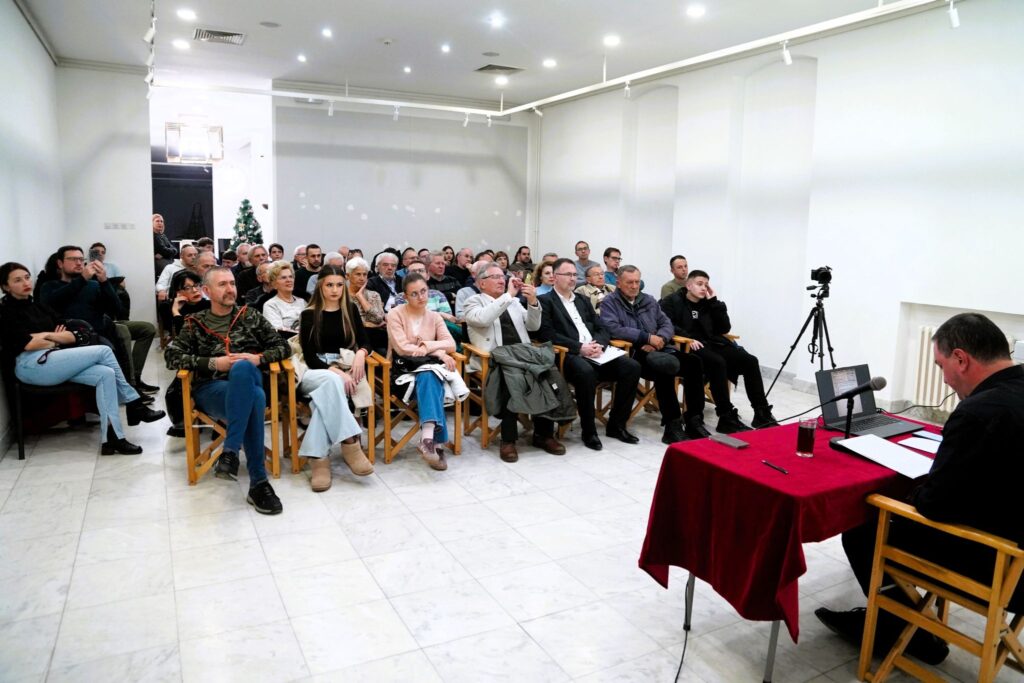
He emphasized the painful reality that no German or Austrian president or chancellor has officially apologized for the 1941 massacres in Serbia. While German leaders have long visited sites of suffering in Russia, France, Greece, and Poland, Serbia has remained a “gap on the map of German memory”. Only in 2021 did Claudia Roth express an apology in Šumarice, acknowledging shame over the neglect of Serbian sites of suffering and promising their inclusion in German school curricula—a promise yet to be fulfilled.
Karamijalković’s lecture represents an important contribution to illuminating not only the crimes of autumn 1941 but also the complex historical, ideological, and personal motives of those who carried them out. His research reveals the depths of Nazi and Austrian anti-Serbian narratives, the mechanisms of command responsibility, and the postwar culture of impunity that left a profound mark on Serbia’s collective memory. The lecture reaffirmed that researching, documenting, and publicly presenting these themes remains essential to the culture of remembrance and the mission of the National Museum Kraljevo.