
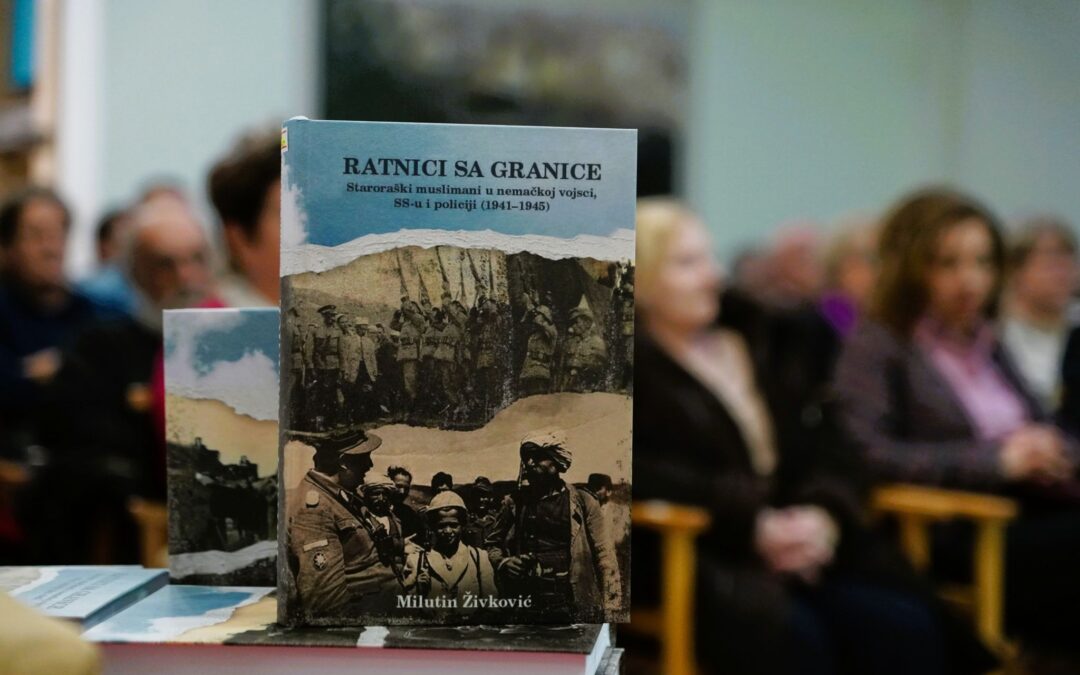
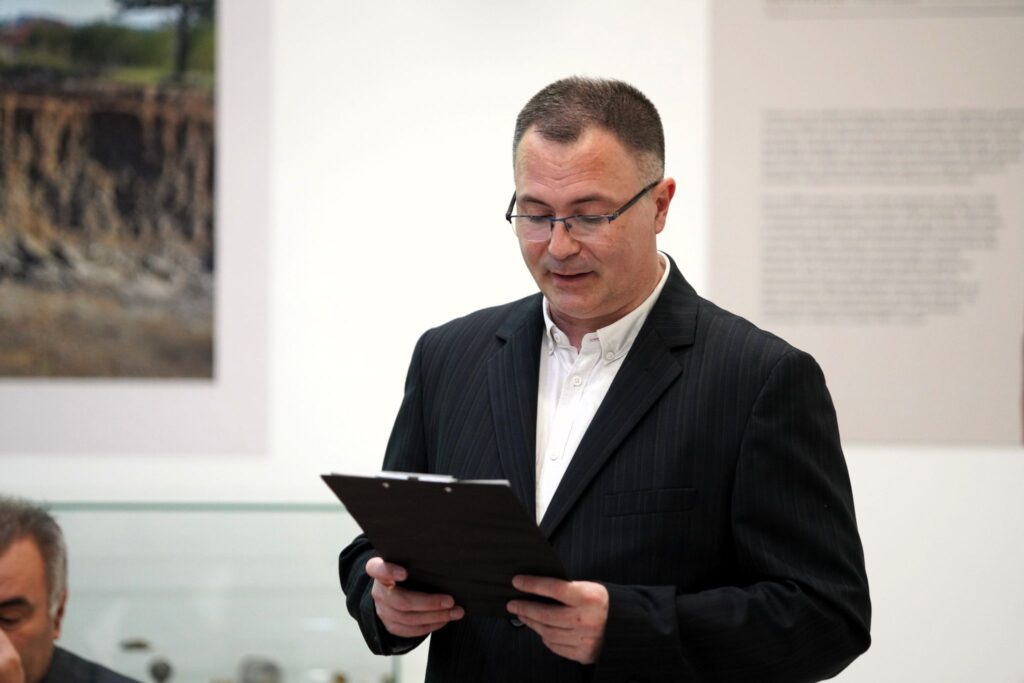
The promotion of the monograph by Milutin Živković “Warriors from the Border. Old Raška Muslims in the German Army, SS, and Police (1941–1945)” was held at the Gallery of the National Museum Kraljevo, on Tuesday, March 3rd, 2026, starting at 6 PM. At the beginning, the audience was addressed by Darko Gučanin, director of the National Museum Kraljevo, who emphasized that although it seems that the events in the territory of the former Kingdom of Yugoslavia during the Second World War have already been thoroughly researched after the liberation of historiography from ideological constraints, there still remain numerous topics that require new, objective, and archive‑based studies. He particularly stressed that certain questions, such as wartime collaboration, are still sensitive and demand scholarly responsibility and research courage.
Speaking about the author, the director reminded that Dr. Milutin Živković dedicated an entire decade of research work to studying the Raška region and wartime events. His approach is based on objectivity and a critical attitude toward sources, without ideological or national prejudices, relying on archival material of Yugoslav, but also German, Italian, and Albanian provenance, as well as relevant scholarly literature. The result of that work is a monograph that provides answers to controversial questions about the participation of part of the local Muslim population in the occupation system, the reasons and scope of collaboration with the occupier, as well as the postwar fate of collaborators. Of special value in the publication are previously unpublished lists of members of German military formations and numerous archival photo documents.
He then introduced the audience to biographical data about the author of the monograph. Milutin Živković, PhD, was born in 1986 in Kraljevo, where he completed elementary school and gymnasium. He finished undergraduate and doctoral studies in history at the Faculty of Philosophy, University of Belgrade. He is employed as a
senior research associate at the Institute for Contemporary History of Serbia and is the author of three monographs and more than fifty scholarly papers.
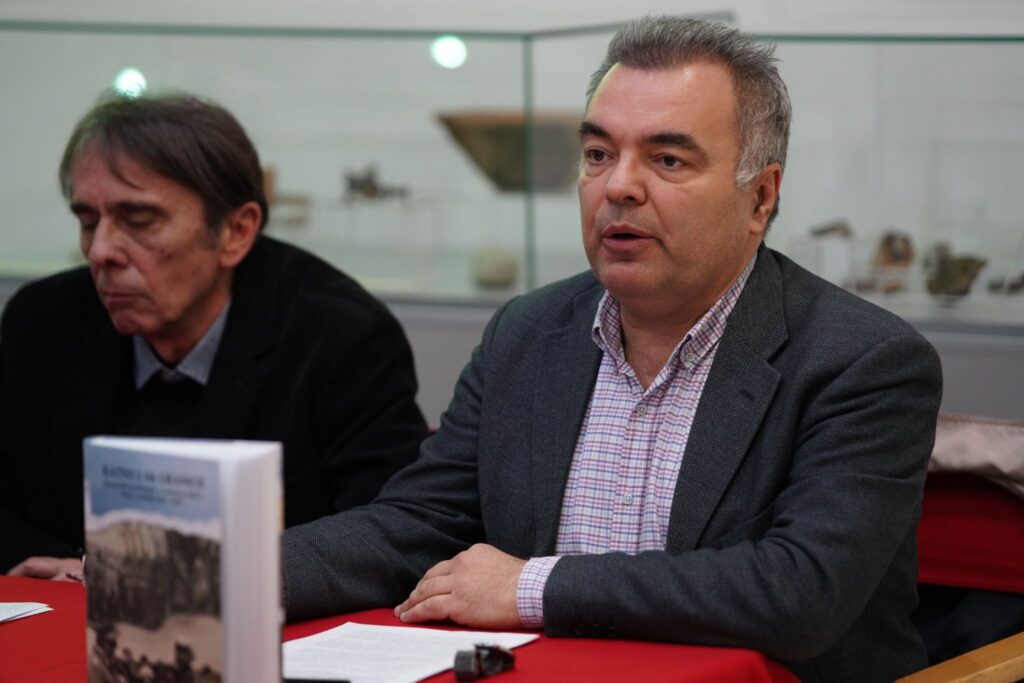
Reviewer of the monograph Bojan Dimitrijević, PhD, research advisor at the Institute for Contemporary History in Belgrade, reminded that Živković matured within the Institute for Contemporary History, an institution recognized for research of 20th‑century history, especially the period of the Second World War. Although he began his career in the field of culture, his research potential was recognized and directed toward serious scholarly work.
Speaking about the book, Dimitrijević emphasized that Živković has for years been engaged with the Raška region, Sandžak, and northern Kosovo – topics which, as he noted, have long been marginalized in Serbian historiography. That area during the Second World War represented a complex border zone between different occupation administrations – German, Italian, and the authorities of the NDH – with strong influences of Serbian, Muslim, and Albanian political factors. It is precisely this multilayeredness and intertwining of interests that the author analyses on the basis of extensive archival material.
A special contribution of the book, according to Dimitrijević, is the research into the participation of Muslims from the Sandžak region in occupation formations, including German police units and SS divisions such as the 13th “Handžar” and the 21st “Skenderbeg”. Živković, however, shows that among the members of these units there were not only residents of Bosnia or Kosovo, but also a significant number of people from the Sandžak, which has not been sufficiently researched so far.
Dimitrijević also pointed out the important fact that some members of these formations were prosecuted after 1944–1945, while some switched to the side of the Partisans and joined the new government structures. The lack of personnel from the Muslim population made it possible for part of the war past to be suppressed and forgotten, which left long-term consequences for interethnic relations in the region.
He pointed out that the book also provides broader historical insights, including data on the participation of Muslims from this region in the Austro-Hungarian army during World War I, as well as an analysis of the political aspirations of local elites in 1941. According to the sources cited by Živković, part of the Muslim elite was not in favor of the Yugoslav state, and in some circles there was a certain nostalgia for the Ottoman heritage. Political aspirations ranged from joining Bosnia within the Independent State of Croatia, through orientation towards Greater Albania via Kosovo, to ideas about special autonomy.
One of the conclusions of the book was particularly emphasized: that the number of Muslim recruits in certain formations was connected with the local dynamics of conflicts and suffering, which, according to Dimitrijević, represents an important contribution to understanding wartime reality and breaks simplified interpretations.
At the end of his address, Bojan Dimitrijevićm, PhD, assessed that “Warriors from the Border” represents a pioneering and courageous research endeavour that opens new questions and encourages further studies. The book, as he pointed out, does not offer simple answers, but a complex picture of wartime experiences and political orientations in a sensitive and historically important area.
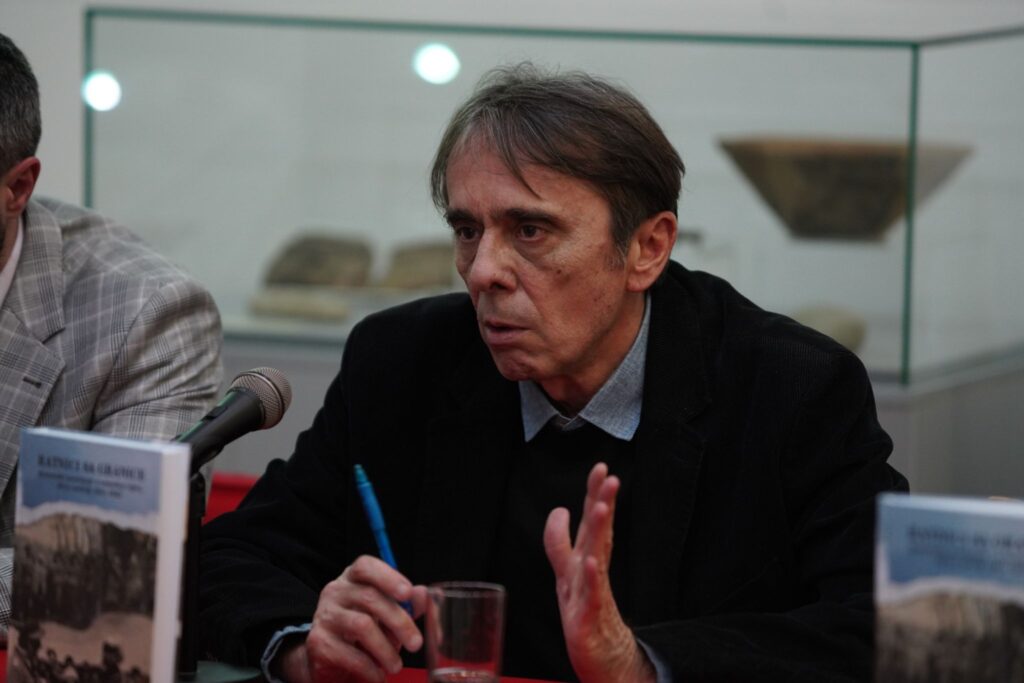
Then the audience was addressed by Kosta Nikolić, PhD, research advisor at the Institute for Contemporary History in Belgrade, who in his presentation particularly emphasized the importance of the topic, the methodological approach, and the broader historical context in which the book is placed.
Nikolić stressed that he has followed the author’s scholarly work for years and that Živković belongs to the circle of historians who consistently respect classical professional standards – reliance on
archival material, verifiable facts, and critical analysis of sources, without ideological or political bias. According to him, precisely such an approach represents the fundamental value of this book.
Speaking about the broader framework, Nikolić reminded that the Second World War in these areas lasted only four years, but that its consequences were deep and long‑lasting. He pointed out that after 1945 historiography was strongly shaped by the dominant partisan narrative, while after the 1990s there came a new wave of interpretations, often burdened with ideological revisions. Today, as he emphasized, research of that period must return to strict scholarly principles, to which Živković’s book makes a significant contribution.
He particularly emphasized that the author deals with the sensitive topic of the participation of Muslims from the area of Old Raška and Sandžak in German military formations during the war, from the capitulation of Italy in September 1943 to the liberation of Priboj in January 1945, including elite units of the Third Reich. Nikolić assessed that it is important to understand the social structure and motivation of these people, without simplifications and generalizations. He reminded that collaboration was not exclusively a local phenomenon, but part of broader European processes in conditions of war and occupation.
One of the key topics of his presentation was the question of the status of Sandžak after 1945. Nikolić reminded of the complex political debates about whether that area would receive a special status or be divided between Serbia and Montenegro, which was ultimately done. Namely, the border was returned to that of 1913. He pointed out the existence of different political currents within the partisan movement, as well as the fact that decisions were made in the broader context of the federal organization of the new Yugoslavia. Указао је на постојање различитих политичких струја унутар партизанског покрета, као и на чињеницу да су одлуке донете у ширем контексту федералног уређења нове Југославије.
He also drew attention to the fact that in different periods of postwar history the attitude toward this topic changed, and that it was not always simple to deal with questions of collaboration and interethnic relations. He reminded of cases when certain historical works encountered resistance or condemnation, even the burning of journals, which testifies to the sensitivity of the topic.
Concluding his presentation, Kosta Nikolić, PhD, assessed that “Warriors from the Border” represents a serious, source‑based, and clearly written work that contributes to understanding the complex wartime and postwar processes in the area of Sandžak and Old Raška. He emphasized that precisely such historiography – free of
ideological prejudices and based on documents – is necessary in order for the past to be understood in all its complexity.
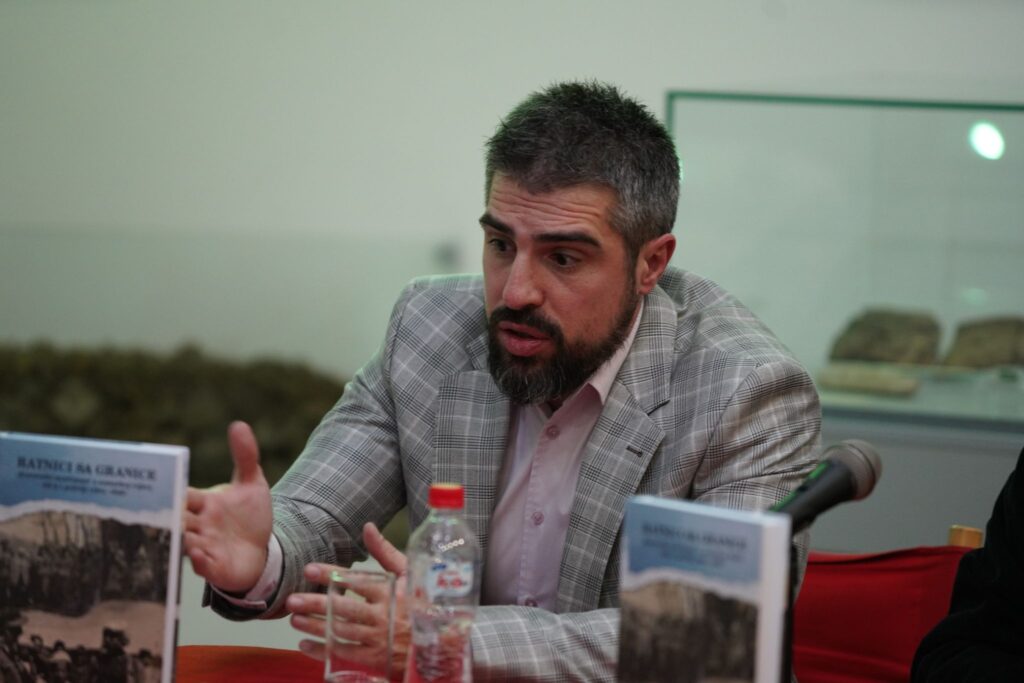
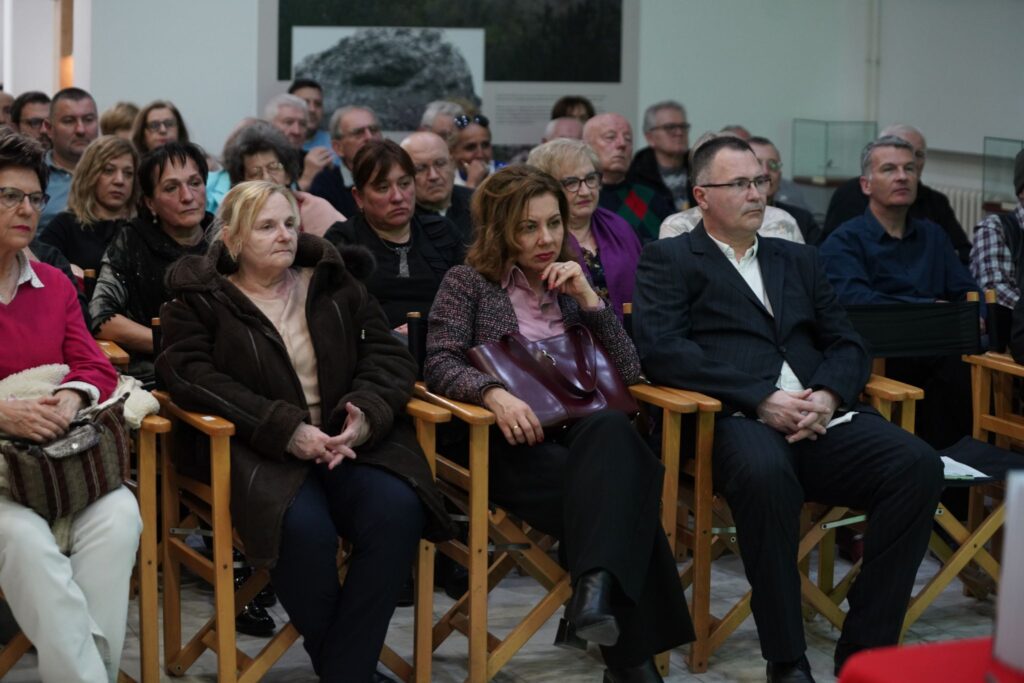
The author of the monograph, Milutin Živković, PhD, addressed the audience in a more personal and direct tone. He thanked the hosts and the audience for coming, emphasizing that he was especially glad that there was not enough seating in the museum space, because that shows that interest in history still exists.
Unlike the previous speakers, who analyzed the scholarly significance of the book, Živković decided to bring the audience closer to the very process of creating the work – what historical research actually means and how much effort stands behind a scholarly monograph.
He explained that the first and most difficult step is collecting archival material. When it comes to the Second World War in the area of Old Raška and Sandžak, documentation is scattered across numerous archives and collections: German, Italian, Bulgarian, Serbian, partisan, Chetnik, and Croatian collections. In the Military Archive in Belgrade alone, material is distributed across dozens of collections, with hundreds of boxes, each containing a large number of documents. To find several dozen key sources, it is necessary to review thousands of pages.
Živković emphasized that the book was created over almost ten years. During that period, he researched archives in Belgrade, Novi Pazar, Kraljevo, Užice, Kragujevac, Trebinje, as well as abroad – in Rome, Tirana, and Berlin. He spoke in particular about the logistical challenges of working in foreign archives: administrative obstacles, complex procedures, limitations on copying and photographing documents, as well as financial difficulties. He stated that without the support of his institute and colleagues, some research in Rome and Tirana would not have been possible.
One of the most demanding parts of the work was compiling a list of about 1,600 Muslims from the area of Sandžak who during the war wore German uniforms. For each name, he emphasized, there had to be concrete archival evidence. He singled out in particular the work with about 800 files seized in 1945, which for decades were inaccessible to researchers. Due to copying restrictions, he was forced to transcribe data by hand and later systematize it, which required years of patient work and multiple checks.
Speaking about methodology, Živković emphasized that a historian must first thoroughly study existing literature, often in several languages, and then build a clear structure of the work. Writing is
not only a technical act, but a process in which it is necessary to know how to fit facts into a meaningful whole, without ideological burdens. A special challenge was also the use of material in German and Italian, which required additional efforts in translation and interpretation.
He reminded that the idea for the book partly arose from earlier research on the German police leader in Sandžak, Karl von Krempler, whose role opened the broader topic of German occupation administration and local collaborators. From that research nucleus gradually emerged the whole that deals with the period 1943–1945 and the position of Old Raška under German occupation.
At the end of his presentation, Živković emphasized that working on the book was at the same time exhausting and precious. Although filled with numerous obstacles, it represented an experience he would not trade. He thanked colleagues for their support and the audience for their attention, with an emotional note that he was especially sorry that his elementary school history teacher did not live to see the published book.
He concluded his address with the expression of hope that such gatherings will continue in the future, because, as he emphasized, precisely conversation and exchange of arguments represent the essence of historical science.
At the end, the author and reviewers of the monograph answered questions from the audience.